
Power Platform Centre of Excellence
Microsoft Power Platform enables teams to build solutions fast. Without the right structure, that speed can quickly introduce risk, sprawl, and uncertainty.
A Power Platform Centre of Excellence (CoE) gives you the governance, visibility, and operating model needed to scale low-code safely across the business.
What is a Power Platform Centre of Excellence?
A Power Platform CoE is a governance and enablement framework, not just a set of tools.
It brings together people, processes, and technology to ensure Power Apps, Power Automate, Power BI, and Copilot are used securely, consistently, and in line with business priorities.
A mature CoE helps you:
-
Balance innovation with control
-
Empower citizen developers with guardrails
-
Reduce risk without stifling creativity
-
Turn low-code adoption into measurable business outcomes

Our approach to a Power Platform CoE
We focus on building CoEs that work in the real world, not theoretical models that never leave a slide deck.
Azure Strategy and Architecture
We design governance policies that are clear, proportionate, and enforceable. This includes:
-
Environment strategy and data loss prevention (DLP) policies
-
Security, identity, and access models
-
App lifecycle management and ownership standards
The goal is to remove ambiguity, not create red tape.
Enablement for citizen and pro developers
A CoE should raise capability across the organisation. We help you:
-
Define development standards and best practices
-
Provide reusable components and templates
-
Create learning pathways for citizen developers
-
Clarify when solutions should move from low-code to pro-code
This reduces technical debt and improves solution quality over time.
Visibility and insight
You cannot govern what you cannot see. We implement monitoring and reporting to give you:
-
A clear view of apps, flows, usage, and dependencies
-
Insight into risk, adoption, and business impact
-
Data to support investment decisions and prioritisation
Leadership gets answers, not assumptions.
Operating model and ownership
We help define who does what and when:
-
IT, business units, and platform owners
-
Support and escalation models
-
Change, release, and compliance processes
This turns Power Platform into a managed service, not an experiment.
Power Platform CoE services
Talk to the Flyte team about building a CoE that enables innovation without compromise.

What success looks like
A well-run Power Platform CoE delivers tangible outcomes:
-
Faster delivery of business solutions with fewer risks
-
Reduced shadow IT and duplicated effort
-
Higher quality apps that are easier to maintain
-
Clear alignment between low-code initiatives and business strategy
-
Confidence for IT, compliance, and senior leadership
Most importantly, the organisation can scale innovation without fear of losing control.

Who this is for
Our Power Platform CoE service is designed for organisations that:
-
Are seeing rapid Power Platform adoption
-
Want to empower the business without increasing risk
-
Need stronger governance, reporting, and control
-
Are under pressure to demonstrate value and ROI from low-code
Whether you are starting from scratch or need to mature an existing CoE, we tailor the approach to your size, sector, and risk profile.
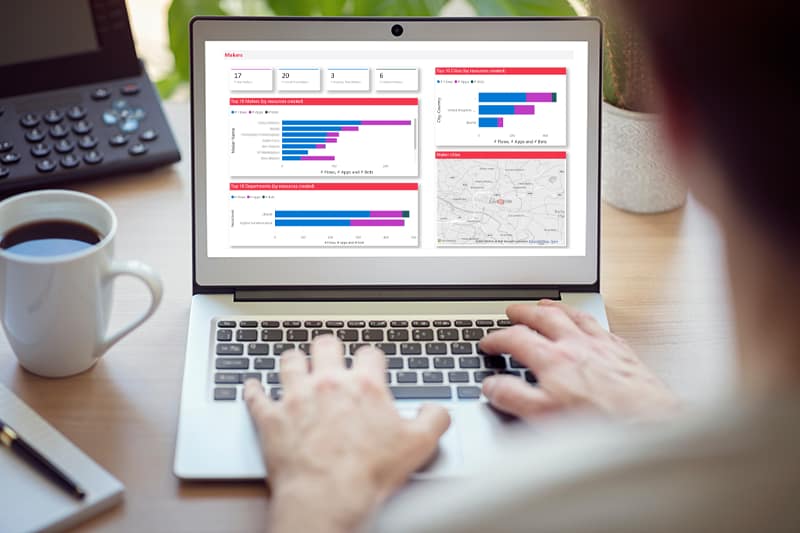
Start with clarity, not complexity
A Centre of Excellence should simplify decision-making, not complicate it. We focus on pragmatic frameworks that evolve with your organisation, not heavyweight models that stall progress.
If Power Platform is becoming business-critical, a CoE is no longer optional.
Speak to us about building a Power Platform Centre of Excellence that scales with confidence.
Key Benefits of a Power Platform CoE
A Power Platform Centre of Excellence (CoE) is not about slowing teams down or adding bureaucracy. It exists to make sure the time, money, and effort invested in low-code delivers measurable business value as adoption grows.
When implemented correctly, a CoE delivers several clear benefits.
Stronger ROI from Low-Code Investment
Without structure, low-code apps are often rebuilt, abandoned, or duplicated across departments. A CoE introduces standards, shared components, and reusable patterns that reduce rework and maximise the return on every app built.
This means fewer wasted development hours and better value from Power Platform licensing.
Reduced Risk and Better Governance
As usage scales, so do risks around data access, security, and compliance. A CoE defines guardrails around environments, data sources, permissions, and app lifecycle management.
This allows teams to innovate quickly while protecting sensitive business data and maintaining regulatory compliance.
Faster, More Consistent Delivery
By providing templates, best practices, and architectural guidance, a CoE removes friction for both citizen developers and IT teams. Apps are built faster, follow consistent standards, and are easier to support long term.
The result is quicker delivery without sacrificing quality or control.
Improved Visibility and Decision-Making
A CoE gives leadership clear insight into how the Power Platform is being used across the organisation. Usage metrics, app performance, and adoption trends help identify what is delivering value and where intervention is needed.
This visibility supports better investment decisions and prioritisation.
Scalable Enablement of the Digital Workforce
Low-code often empowers a new digital workforce of business users building solutions closer to the problem. A CoE provides the training, support, and structure needed to scale this safely.
Instead of isolated experimentation, low-code becomes a repeatable capability that supports growth without increasing headcount.
Lower Support and Maintenance Overhead
Without standards, low-code apps quickly become costly to support. A Power Platform CoE enforces clear ownership and lifecycle management, making apps easier to maintain, update, and retire.
This reduces technical debt and keeps long-term support costs predictable as adoption scales.
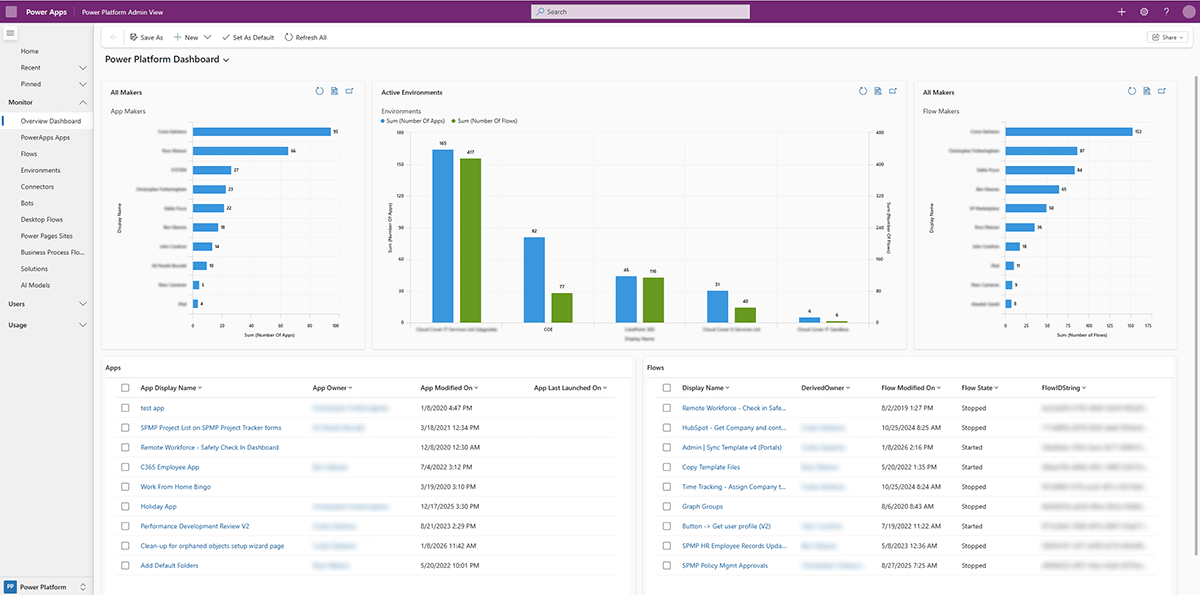
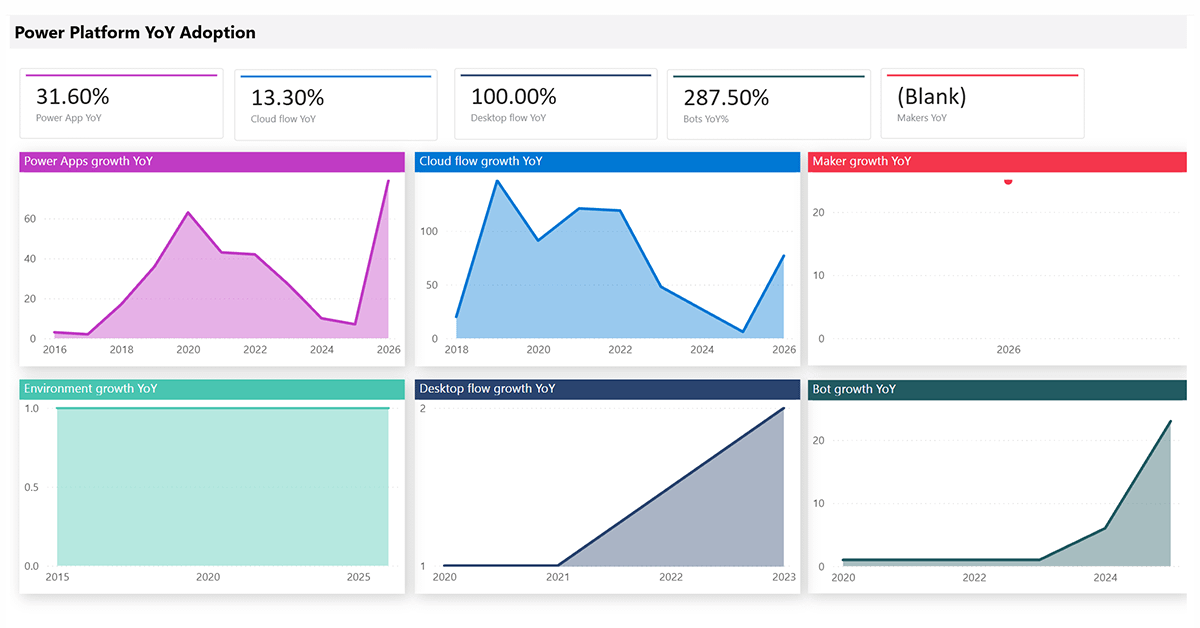
Power Platform CoE Report Examples
Power Platform Centre of Excellence FAQs
What is a Power Platform Centre of Excellence?
A Power Platform Centre of Excellence (CoE) is a framework that defines how Power Apps, Power Automate, Power BI, and Copilot are governed, supported, and scaled across an organisation. It combines governance, enablement, and operational ownership to ensure low-code adoption is secure and sustainable.
Do we need a CoE if Power Platform is already in use?
Yes. Most organisations introduce a CoE after adoption has already started. A CoE helps regain control, improve quality, and reduce risk without disrupting existing apps or teams.
Will a CoE slow down innovation?
No. A well-designed CoE enables faster delivery by removing uncertainty. Clear standards, reusable components, and defined processes reduce rework and escalation, allowing teams to build with confidence.
Is a CoE just an IT function?
No. While IT plays a critical role, a successful CoE is cross-functional. It typically includes IT, security, compliance, and business stakeholders to balance control with business agility.
What’s the difference between Microsoft’s CoE toolkit and a CoE strategy?
Microsoft’s CoE toolkit provides visibility and monitoring tools. A CoE strategy defines how those insights are used. Governance models, ownership, development standards, and decision-making processes must sit alongside the toolkit to be effective.
How long does it take to implement a CoE?
An initial CoE foundation can typically be established in a few weeks. Maturity develops over time as adoption grows, governance evolves, and capabilities expand.
Can a CoE scale as our organisation grows?
Yes. A CoE is designed to evolve. Policies, controls, and operating models are adjusted as usage increases, new workloads are introduced, and risk profiles change.
How do we measure the success of a CoE?
Success is measured through improved visibility, reduced risk, higher-quality solutions, increased adoption, and clearer alignment between Power Platform usage and business outcomes.

Why Microsoft Dataverse Is the Data Foundation Every Serious Power Platform Deployment Needs
The most common Power Platform mistake is not a poorly built app. It is a well-built app sitting on the wrong foundation. Most organisations start their Power Platform journey with SharePoint. That is not a mistake.…

The First 90 Days of a Power Platform Centre of Excellence
Right now, somewhere in your organisation, there could be a business-critical process running inside a Power Platform environment you do not know exists. The app may have been built by someone who has since left. No…

Scaling Low-Code Without Losing Control: The Business Case for a Centre of Excellence (CoE)
Power Platform adoption rarely starts as a strategic programme. A Power App replaces a spreadsheet. A Power Automate flow removes a manual handoff. Someone connects Teams, SharePoint, and Dynamics and suddenly a process that took days…

Designing Tomorrow’s Defences Today: Using Power Platform for Cyber-Secure Business Agility
The way businesses innovate has changed. With the Microsoft Power Platform, teams no longer need to wait months for traditional development cycles. They can create apps, automate workflows, and surface insights in days. But here’s the…

Balancing Speed and Control: Low-Code vs. Web App Development
The pressure on CIOs has never been greater. Business leaders want digital solutions yesterday, while IT teams push back with concerns around integration, compliance, and long-term scalability. Somewhere in the middle sits a decision that defines…

Low-Code Meets Pro-Code: How Power Platform and Azure Work Together for Enterprise Solutions
For many CIOs, the choice between low-code platforms and traditional pro-code development feels like a trade-off: empower business users to innovate quickly, or ensure robust, scalable solutions through enterprise-grade development. The truth is, this isn’t a…

Ethical and Safe AI Development with Microsoft Azure AI Foundry
In the swiftly advancing realm of artificial intelligence (AI), ensuring ethical and safe development practices is paramount. Microsoft Azure AI Foundry stands at the forefront of this mission, offering a robust platform for creating AI solutions…

Unleash Your Potential: How the Microsoft Power Platform is Redefining UK Engineering
At Flyte, we believe in a simple truth: technology should empower people, not hinder them. For the UK’s forward-thinking engineering firms, the path to greater efficiency and innovation is no longer a complex coding challenge. It’s…

Copilot vs ChatGPT: Which is Better for Your UK Business?
The AI arms race is well and truly underway- and for UK businesses, the question isn’t whether to adopt AI, but which tools to adopt. Two names dominate the conversation: Microsoft Copilot and ChatGPT by OpenAI.…

Power Pages: The Fast Track to ROI Through Seamless Customer Engagement
In a digital-first world, customer expectations are higher than ever. They want fast, intuitive, and secure online experiences — and they want them now. For organisations already invested in Microsoft 365, Microsoft Power Pages offers a powerful way…