
The biggest risk with Copilot Studio is not building an agent. It’s what happens after a successful pilot quietly becomes a production service.
Someone on the team puts together a proof of concept over a couple of afternoons. It answers a handful of test questions convincingly and gets a nod in a steering meeting. Six months later, that same agent is answering questions from dozens of users every week, connected to live business data, consuming AI credits and influencing day-to-day decisions. Nobody in IT is entirely sure who owns it, what content it’s grounded on, or how changes are being managed.
This is where Copilot Studio governance becomes critical.
The gap between a pilot and a production system is where ownership, cost management, security and operational accountability start to matter more than prompt quality. Most organisations have seen something similar before. SharePoint sites, Power Apps and Power Automate flows often begin as useful departmental tools before gradually becoming business critical. AI agents simply accelerate that pattern because they are easy to create, easy to publish and increasingly valuable.
The wider market reflects this challenge. Gartner has repeatedly highlighted governance and risk management as key obstacles to scaling generative AI beyond experimentation, while Microsoft’s continued investment in governance capabilities shows the industry’s shift from AI pilots towards managed, enterprise-scale adoption.
Why Copilot Studio Governance Becomes Critical in Production
A Copilot Studio agent that performs well during testing can still create significant governance challenges once adopted at scale.
In my experience, organisations rarely encounter problems because the technology fails. The more common issue is that successful agents outgrow the operational controls that originally surrounded them.
Three governance gaps appear repeatedly.
Ownership Gets Fuzzy
There is a significant difference between the person who builds an agent and the person accountable for its continued operation.
Builders move teams, take on new responsibilities or leave the organisation. Unless ownership is formally assigned, the agent becomes the AI equivalent of an orphaned SharePoint site: still running, still accessing business information and ultimately owned by nobody.
Most IT teams have inherited applications and automations where no one can confidently explain who is responsible for maintenance or approvals. The same thing can happen with agents unless ownership is established before production deployment.
Grounding Data Is Not the Same as Trusted Data
One of the most common misconceptions in AI agent governance is assuming that authorised access automatically means trusted information.
An agent may have permission to access a knowledge source, but that does not confirm the content is accurate, current or appropriate for answering business questions.
Permission to access information is not evidence that the information is reliable.
As organisations connect agents to SharePoint, business systems and departmental repositories, governance must focus not only on accessibility but also on content quality, ownership and lifecycle management.
Audit Questions Always Arrive Eventually
For months, everything can appear to be working perfectly.
Then a compliance, legal or security question arrives:
- What did the agent tell this user?
- What information was used to generate the answer?
- Can we demonstrate what happened?
For any production system handling real users or business data, uncertainty is not a sufficient response.
Auditability rarely becomes a priority until evidence is needed. By then, it may already be too late.
None of these challenges appear during a successful demonstration. They emerge later, once the agent has become embedded in normal business operations.
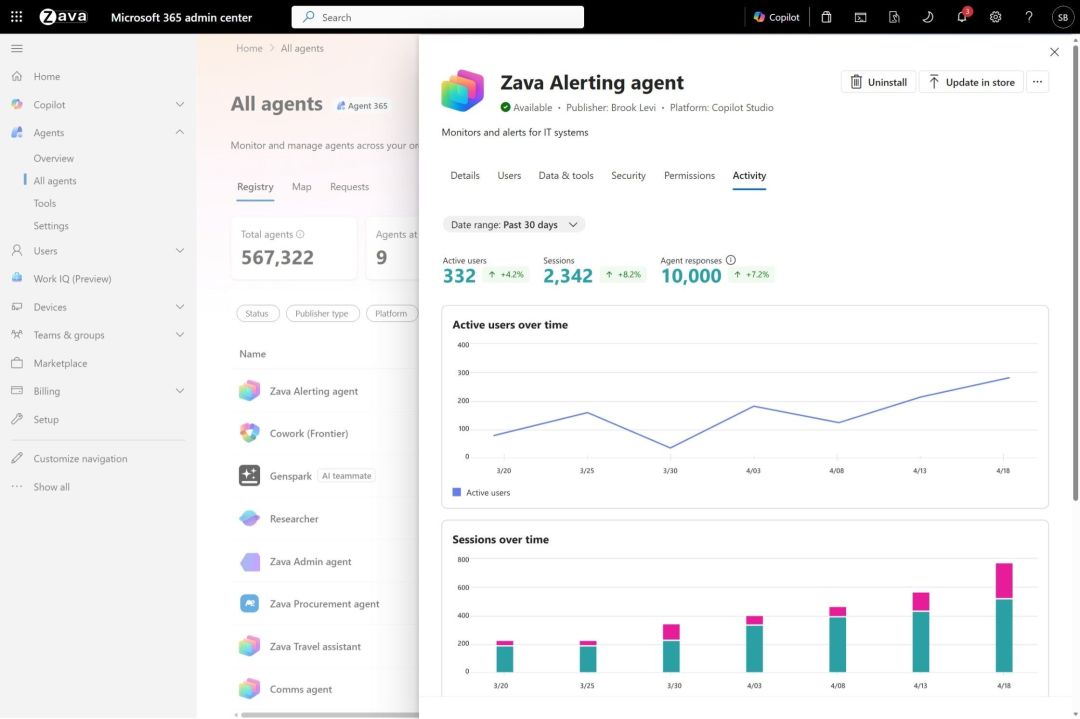
Microsoft Agent 365: a control plane for observing, governing and securing AI agents at scale
How Microsoft Agent 365 Improves AI Agent Governance
The good news is that governance tooling is catching up.
Microsoft recently introduced Microsoft Agent 365, positioning it as a control plane for observing, governing and securing AI agents at scale. Microsoft describes it as a way for organisations to gain visibility into agent usage, governance status and security controls across their agent ecosystem.
For organisations developing an enterprise AI governance framework, Microsoft Agent 365 is an important step towards centralised AI agent management, helping IT teams understand:
- What agents exist
- How they are being used
- Where governance controls need to be applied
Alongside this, Copilot Studio has continued expanding its governance and security capabilities, surfacing protection and security status directly within the authoring experience.
The tools themselves are becoming increasingly capable.
The bigger challenge is ensuring organisations apply them consistently before agents move beyond pilot deployments.
Six Copilot Studio Governance Controls Every Production Agent Needs
The difference between a proof of concept and a production-ready AI service rarely comes down to the agent itself.
It comes down to the operational controls surrounding it.
- Assign a Named Owner, Not Just a Builder
Every production agent should have a specifically identified owner.
That person or role should be responsible for reviewing performance, approving major changes, validating business value and deciding when an agent should be retired.
Ownership is a production prerequisite, not an incident response activity.
- Separate Test and Production Environments
Development and production environments should operate with different permissions, publishing rights and data access boundaries.
An agent that can move directly from testing into production without validation introduces avoidable operational risk.
The same change control principles used for applications and infrastructure should apply to Copilot Studio production deployments.
- Track Cost Per Agent, Not Just Per Tenant
As AI adoption grows, consumption tends to increase unevenly.
Some agents become widely adopted while others remain lightly used.
Tracking cost at an individual agent level provides greater visibility into business value, supports budgeting discussions and helps prevent unexpected consumption patterns from going unnoticed.
- Apply Data Loss Prevention and Information Protection Controls
A robust AI governance framework should treat agent access with the same rigour applied to employees.
Data Loss Prevention (DLP) policies and Microsoft Information Protection controls help determine what agents can access, what information can be processed and what actions can be performed.
Effective Copilot Studio security depends on governing data appropriately rather than simply granting technical permissions.
- Build a Proper Deployment Pipeline with Rollback
Business critical agents should not be modified directly in production.
Source-controlled deployments and rollback capabilities introduce the governance discipline necessary to support reliable operations.
When unexpected behaviour occurs, recovery should be a defined process rather than an emergency response.
- Make Auditability a Default Setting
Audit trails should exist from day one.
This becomes especially important once agents move beyond internal knowledge queries and begin supporting customer interactions, regulated processes or operational decision-making.
Strong AI agent lifecycle management requires organisations to understand what happened, when it happened and why it happened.

Microsoft Purview: Provides a centralised view of your agents across your organisation
Production-Ready Copilot Studio Agents Need More Than Accuracy
It is tempting to evaluate production readiness through a purely technical lens.
Is the agent accurate?
Is it reliable?
Does it perform well?
Those questions matter, but they are rarely what determines whether an organisation can confidently scale AI.
The organisations succeeding with Copilot Studio governance are building ownership, environment separation, data controls and cost management into their deployment approach from the outset.
Before approving the next rollout, ask three simple questions:
- Who owns this agent?
- What information is it grounded on?
- Could we produce a complete audit trail tomorrow?
If any of those answers require investigation, the agent may be deployed, but it is not yet operationally mature.
The Real Challenge Starts After the Pilot Succeeds
As AI agent adoption accelerates, the organisations that scale successfully will not necessarily be those building the most agents. They will be the ones that understand exactly what their agents do, what information they can access, who is accountable for them and how governance is maintained long after the pilot phase has ended.
Many organisations already have Copilot Studio agents running in production without a clear ownership model, governance framework or complete inventory of what is deployed. What starts as a successful proof of concept can quickly become a business critical service operating outside established controls.
If you’re unsure whether your existing agents would stand up to a governance, security or audit review, now is the right time to find out. Flyte helps organisations build the foundations required to scale Copilot Studio safely, from Power Platform governance and Centre of Excellence design through to Microsoft Agent 365 adoption, security controls and AI agent lifecycle management.
Whether you’re preparing to move your first agent into production or trying to regain visibility and control over what’s already running across your tenant, Flyte can provide an independent assessment of your current governance posture, identify gaps and help you establish the operational controls needed to scale with confidence. Get in touch with our team to discuss your Copilot Studio roadmap and ensure today’s successful pilot doesn’t become tomorrow’s governance problem.