
Most organisations spend considerable time evaluating low-code platforms before rollout.
Far fewer spend the same amount of time considering what happens after success.
Once Microsoft Power Platform becomes embedded across multiple business units, many of the initial challenges disappear. Security concerns have been addressed. Adoption is established. Teams are building solutions. Business processes are running more efficiently.
The platform is delivering exactly what it was supposed to deliver.
Yet this is often where a new and more complex challenge begins.
The questions are no longer about technology selection or implementation. They are about governance, ownership, demand management and sustainability. In other words, they are operating model questions.
And they are the questions many organisations stop asking too soon.
Scaling Low-Code Platforms Without Creating New Bottlenecks
One of the biggest advantages of low-code is its ability to unlock demand that previously sat hidden across the business.
Departments that once relied on spreadsheets, shared mailboxes and manual workarounds can suddenly identify opportunities to automate and improve processes. Teams that rarely engaged central IT are empowered to solve problems independently through low-code business applications.
Initially, this is exactly what organisations want.
That success, however, creates a new challenge: deciding how to manage rising demand without slowing the business back down.
When Demand Outpaces Governance
As adoption grows, so does expectation.
Business users see new opportunities. Departments submit enhancement requests. New workflows, reports and integrations are proposed. What started as a platform designed to increase agility can quickly become a victim of its own success.
The backlog grows.
Prioritisation becomes harder.
The pressure on internal teams increases.
At this point, scaling low-code platforms requires an entirely different mindset from implementing them.
Avoiding the Centralisation Trap
CIOs face a familiar dilemma:
- How much responsibility should sit within central IT?
- How much ownership should move into business teams?
- How can innovation be encouraged without creating governance risk?
A fully centralised model often recreates the same bottlenecks low-code was intended to remove. A completely decentralised approach can result in duplication, inconsistent standards and fragmented ownership.
The organisations that scale successfully typically focus less on controlling development and more on establishing a clear low-code operating model.
Responsibility can be distributed. Governance cannot.
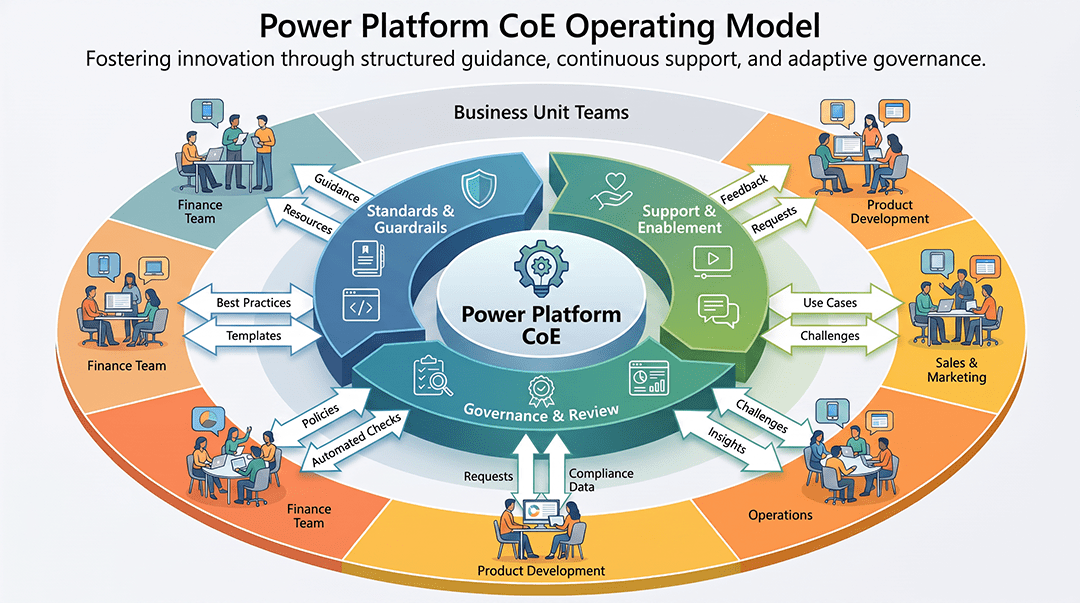
Rather than controlling every application, mature organisations create clear guardrails, development standards and support processes that allow innovation to happen safely.
This is often where ongoing specialist support becomes critical. As organisations move beyond implementation, operational maturity frequently becomes a greater challenge than technical delivery. Flyte’s Power Platform consultancy and managed support services help organisations establish the structures needed to support sustainable growth.
Once those guardrails are in place, the next question is how to maintain quality consistently when more teams are building more solutions.
How to Maintain Quality and Governance Without Centralising Delivery
As adoption increases, maintaining quality becomes less about direct oversight and more about consistency.
During the early stages of a low-code programme, governance is relatively straightforward. There are fewer applications, fewer developers and fewer dependencies.
At scale, things become more complicated.
The Resilience Challenge
Different teams develop different ways of working.
Documentation standards vary.
Support ownership becomes unclear.
Business-critical applications emerge in unexpected places.
The biggest risk is often not technical failure. Many solutions continue performing exactly as intended.
The bigger issue is resilience.
Most CIOs have encountered situations where a critical business solution is effectively owned by one individual. When that person changes role or leaves the organisation, the associated risks suddenly become very visible.
Building Enterprise Low-Code Governance
This is where enterprise low-code governance becomes essential.
Effective governance frameworks typically include:
- Solution lifecycle management
- Documentation standards
- Data governance policies
- Security reviews
- Environment strategies
- Change management processes
- Support ownership models
The objective is not to introduce unnecessary bureaucracy.
Nor is it to make low-code development feel like traditional software engineering.
The objective is to ensure solutions remain supportable, secure and maintainable as they grow in importance.
For organisations running Microsoft business applications, governance often extends across Power Apps, Power Automate, Dataverse, SharePoint and Microsoft Teams. Establishing a coherent approach becomes increasingly important as adoption grows. Flyte’s Power Platform and Microsoft 365 consultancy services help organisations build governance frameworks that enable innovation without sacrificing control.
The Role of a Centre of Excellence
The most effective Power Platform Centres of Excellence (CoEs) act as enablers rather than gatekeepers.
Their role is to provide standards, best practices and support structures that allow teams to innovate confidently.
When implemented well, a CoE reduces risk while improving delivery speed.
When implemented poorly, it simply becomes another bottleneck.
The distinction matters.
Quality and governance provide the foundation, but they also raise an important delivery question: which problems should low-code solve, and which require professional development?
When Should CIOs Choose Low-Code vs Pro-Code Development?
Few discussions become more politically charged than deciding where low-code ends and professional development begins.
By the time organisations reach platform maturity, this question becomes unavoidable.
Moving Beyond Technology Bias
Low-code advocates often point to speed and agility.
Traditional development teams often focus on scalability, flexibility and long-term architecture.
Both perspectives are valid.
The problem occurs when technology preferences drive decision-making.
The most successful organisations move beyond this debate entirely.
Instead of asking which approach is superior, they ask a far more useful question:
What is the most appropriate way to solve this particular business problem?
Choosing the Right Tool for the Outcome
That subtle shift changes everything.
Rather than defending technologies, teams evaluate solutions based on:
- Business value
- Delivery timelines
- Integration complexity
- Maintenance requirements
- User experience
- Long-term scalability
In mature environments, the answer is rarely either low-code or pro-code.
It is usually both.
The strongest digital organisations combine Power Platform delivery with Azure, .NET, SQL and modern application development capabilities to create solutions that are fit for purpose and sustainable over time.
Once organisations accept that both approaches have a role, the practical challenge becomes deciding which opportunities deserve attention first.

Managing Low-Code Demand at Scale Across Business Units
Demand management becomes increasingly important as adoption grows.
The challenge is not generating ideas.
The challenge is choosing the right ideas.
Shifting from Activity Metrics to Business Outcomes
Without a structured approach, organisations can easily become overwhelmed by requests.
Hundreds of potential opportunities emerge. Some provide transformational value. Others offer only marginal improvements.
If every request receives equal attention, resources become diluted.
Mature organisations recognise that application volume is a poor measure of success.
Instead, they focus on outcomes.
Questions become more strategic:
- Which opportunities deliver measurable efficiency gains?
- Which projects support wider business objectives?
- Which automations reduce operational risk?
- Which solutions provide the greatest return on investment?
This creates a far more effective framework for prioritisation.
A Better Demand Management Model
The goal is not to reject ideas.
The goal is to ensure resources are directed towards the opportunities that deliver the greatest value.
Strong citizen development governance helps organisations strike this balance. Teams retain the freedom to innovate while maintaining alignment with broader organisational priorities.
Many organisations discover that periodic governance reviews and advisory support become increasingly valuable as platform adoption expands across departments and business functions.
Prioritising the right work is only part of the equation; leaders also need to keep showing why the platform continues to matter.

Sustaining Executive Confidence in Business-Critical Low-Code Platforms
Ironically, one of the biggest threats to a successful low-code programme is invisibility.
When platforms work well, people stop talking about them.
Success Can Create a Visibility Problem
Applications operate reliably.
Processes become more efficient.
Users achieve better outcomes.
The platform fades into the background.
Operationally, that is excellent.
Strategically, it can create challenges.
As low-code becomes part of business as usual, executives may begin to view it as infrastructure rather than transformation. Investment conversations move elsewhere. New priorities emerge. Budget scrutiny increases.
Without visibility into the value being delivered, even successful platforms can struggle to maintain executive attention.
Keeping the Value Story Alive
The most effective CIOs actively address this issue.
They consistently communicate platform outcomes using metrics that matter to business leaders:
- Hours of manual work removed
- Reduction in process cycle times
- Compliance improvements
- Cost savings
- Service enhancements
- Adoption metrics
- Productivity gains
These discussions reinforce an important point.
Success is not measured by the number of applications created.
Success is measured by the business value those applications generate.
A good example is Flyte’s work supporting organisations such as Whyte & Mackay through ongoing Power Platform support and governance. The objective is not simply to deliver solutions but to ensure those solutions continue providing value long after implementation. Explore Flyte’s customer success stories to see how this approach delivers long-term outcomes.
This is where the discussion comes full circle: the long-term value of low-code depends less on the platform itself and more on the operating model around it.

Why Low-Code Governance and Operating Models Matter More Than Technology
Most organisations spend substantial time evaluating low-code technology.
Far fewer devote the same attention to the operating model required to sustain it.
Yet once a platform becomes business-critical, leadership decisions matter far more than platform features.
The organisations achieving the greatest long-term success are not necessarily the ones building the most applications.
They are the organisations that establish clear answers to the questions that emerge after adoption:
- Who owns governance?
- How is demand prioritised?
- Where does pro-code fit?
- How is quality maintained?
- How is value communicated?
Technology enables transformation. Operating models determine whether it scales.
At Flyte, we regularly work with organisations that have already proven the value of Microsoft Power Platform. The conversation is no longer about implementing low-code. It is about creating the governance structures, support frameworks and delivery models that allow platforms to continue evolving as strategic business assets.
Because the real challenge is rarely whether low-code works.
It’s whether your organisation is prepared for what happens when it succeeds.
Ready to Scale with Confidence?
If your organisation is seeing increasing Power Platform adoption and you’re starting to face challenges around governance, ownership, demand management or support, now is the time to review your operating model.
Flyte helps organisations build the governance frameworks, Centres of Excellence, support models and strategic roadmaps needed to scale low-code safely and sustainably.
Contact Flyte today to discuss how we can help you maximise the long-term value of your Power Platform investment and turn low-code success into a lasting competitive advantage.