
The latest Microsoft Copilot announcement marks a shift from AI-assisted productivity towards AI-powered applications, automation and organisational knowledge. For business and IT leaders, the challenge is no longer whether Copilot can be useful, but how to govern it, support it and manage costs as adoption grows.
Many of these capabilities are currently being introduced through Microsoft’s Frontier programme and preview releases, meaning functionality, availability and pricing may change before general availability.
Why This Update Matters
Microsoft has introduced a redesigned Copilot experience built around three new capabilities: Home, Code and Autopilot.
Taken together, these updates suggest Microsoft is expanding Copilot beyond personal productivity and towards a platform for building applications, running AI agents and connecting organisational knowledge.
For many organisations, the questions are no longer technical. They’re operational. Who can create AI-powered solutions? How are they governed? What data can they access? And how will usage be funded as AI moves towards consumption-based charging?
A New Starting Point for AI at Work
Home becomes the central Copilot experience, bringing together Chat and Cowork in one place. Microsoft has also integrated Word, Excel and PowerPoint directly into the experience through Office in Copilot, making it easier to move from conversations into real work without switching applications.
Microsoft has also indicated that future updates will route requests automatically between Chat, Cowork and Code depending on the task being asked of Copilot.
While this may seem like a user experience improvement, it also signals Microsoft’s ambition to make Copilot the primary interface between employees, data and business processes.
Bringing App Development to More People
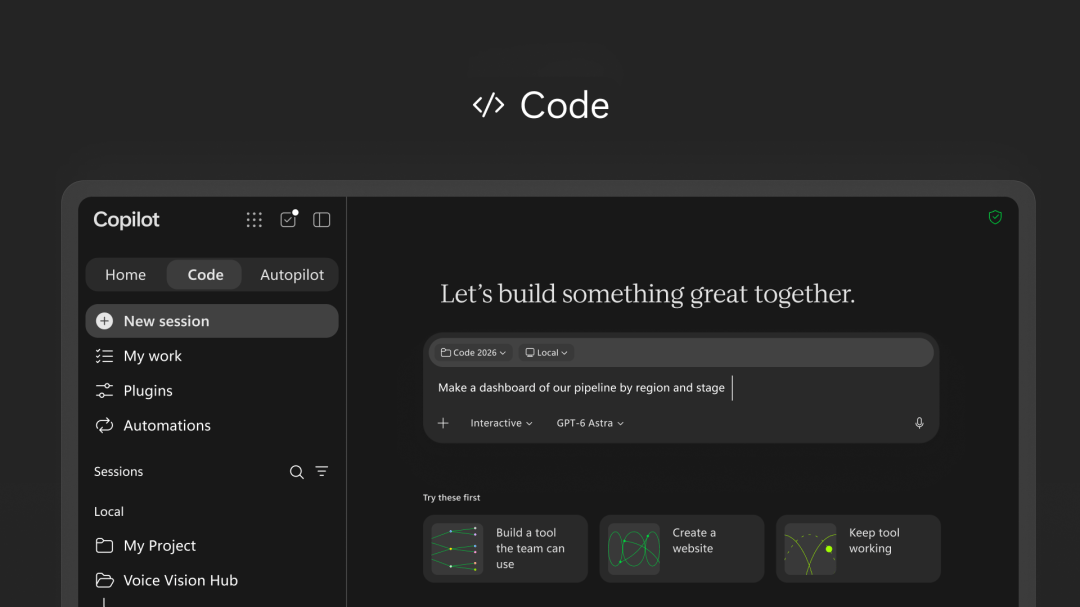
One of the most significant announcements is Code.
Code allows users to describe an app, workflow, dashboard, automation or tracker using natural language and have Copilot generate an initial working solution that can be refined and published. Microsoft says it is powered by the same underlying technology as GitHub Copilot while retaining enterprise governance and security controls.
For organisations already invested in Power Platform, this is where the conversation becomes particularly interesting. As low-code adoption grows, governance becomes increasingly important. Our article on Power Platform Governance at Scale explores how organisations can balance innovation with control.
The ability to create solutions more quickly will undoubtedly increase demand from business users. However, faster development also increases the need for governance, ownership, support models and lifecycle management. The challenge isn’t whether employees can build applications. It’s ensuring those applications remain secure, supported and aligned with organisational standards.
From Assistance to Automation
Autopilot takes Copilot beyond responding to prompts and into autonomous execution.
Previously known as Scout, Autopilot acts as a persistent AI agent with its own identity, memory and workspace. It can continue working in the background across Microsoft 365 services and can be interacted with through Teams, Outlook and other familiar tools.
Microsoft has emphasised that governance, permissions and audit controls remain in place. However, the introduction of persistent agents raises new questions around accountability, monitoring and oversight.
As organisations begin deploying AI agents at scale, clear ownership and governance processes will become increasingly important. We recently explored this challenge in Copilot Studio Governance: What Changes When Agents Move from Pilot to Production.

Work IQ and Business Data Grounding
Microsoft is also expanding how Copilot accesses business information.
Work IQ helps bring organisational knowledge into Copilot, while Fabric IQ enables grounding using organisational data, including Power BI semantic models. Microsoft has also announced preview support for Dynamics 365 and Power Platform data, further expanding the business context available to Copilot.
This should help Copilot deliver more relevant responses based on trusted business information.
For organisations, this reinforces a message we’ve been discussing for some time: successful AI starts with trusted data. Our recent article on Why Data Strategy Is the Foundation for Enterprise AI Success explores why organisations with strong data foundations are seeing better AI outcomes.
The more useful Copilot becomes, the more important data quality, ownership and governance become. Organisations preparing for Microsoft 365 Copilot should also consider How to Reduce AI Data Risk with Microsoft Purview before scaling adoption.
Understanding the Cost Implications
Microsoft is also signalling a shift in how AI will be funded.
While a user subscription licence remains central to day-to-day Copilot use, Microsoft is increasingly introducing consumption-based models for more advanced AI workloads, including autonomous agents, Copilot-powered applications and other agentic experiences.
For many organisations, this represents a move away from predictable licence-only costs towards a model where usage directly influences expenditure.
That doesn’t mean costs will necessarily increase. However, it does mean finance, IT and business teams will need clearer visibility into how AI services are being used and who is responsible for them.
As AI adoption grows, organisations should ensure governance, ownership and reporting processes mature alongside it. This is a common theme in successful low-code and AI programmes and closely aligns with building a sustainable Power Platform Centre of Excellence.
Four Priorities Before You Scale Adoption
1. Improve Data Quality
Copilot is only as effective as the data it can access. Organisations should review data quality, permissions and ownership before expanding AI usage.
Power BI semantic models are increasingly becoming part of the AI foundation organisations rely on to provide trusted answers.
Organisations looking to establish stronger foundations should start with a clear data strategy and governance framework. Why Data Strategy Is the Foundation for Enterprise AI Success provides a practical starting point.
2. Apply Governance to AI Agents
AI agents should be treated like any other business-critical service, with defined ownership, monitoring and lifecycle controls.
Organisations that establish governance early will be better placed to scale adoption safely as agent-based scenarios become more common.
3. Put Controls Around New Solutions
As Code lowers the barrier to creating applications and automations, organisations need to ensure governance frameworks evolve at the same pace.
Our guide to Power Platform Governance at Scale explores what this looks like in practice.
4. Prepare for New Cost Models
Monitoring, reporting and approval processes should be established now so organisations are prepared as consumption-based charging becomes more common.
Clear ownership of AI usage and spend will become increasingly important as adoption grows.
Our View
There’s no need to rush into every new Copilot capability as soon as it becomes available.
The organisations most likely to realise long-term value will focus on the fundamentals first: trusted data, clear governance, defined ownership and controlled adoption.
Microsoft is clearly positioning Copilot as more than a productivity assistant. It’s becoming a platform for applications, automation and organisational knowledge. The opportunity is significant, but successful adoption will depend just as much on governance, operating models and data quality as the technology itself.

How Flyte Is Helping Organisations Prepare
At Flyte, we’re helping organisations prepare for the next phase of Copilot adoption through governance, data readiness, Power Platform strategy and AI operating models.
Whether you’re exploring Microsoft Copilot deployment and adoption, reviewing your Data & AI strategy or building a Power Platform Centre of Excellence, the organisations getting the greatest value are those putting the right foundations in place now.
Want to understand what Microsoft’s latest Copilot changes mean for your organisation? Get in touch with the Flyte team to start the conversation.